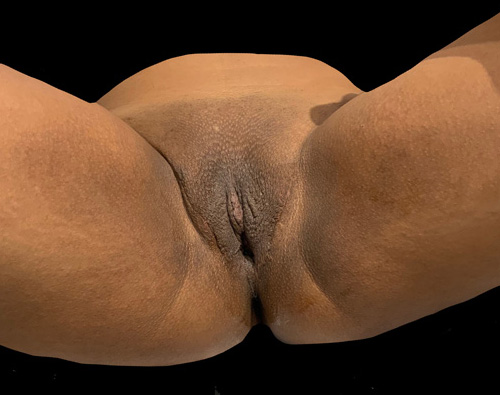

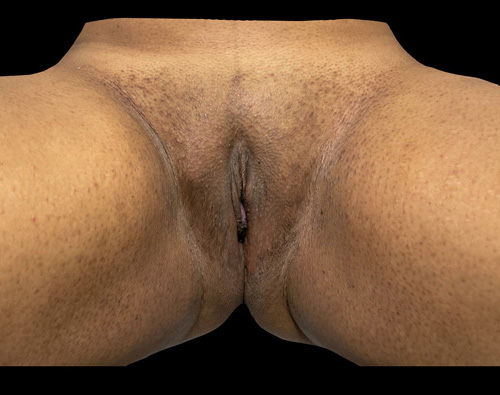
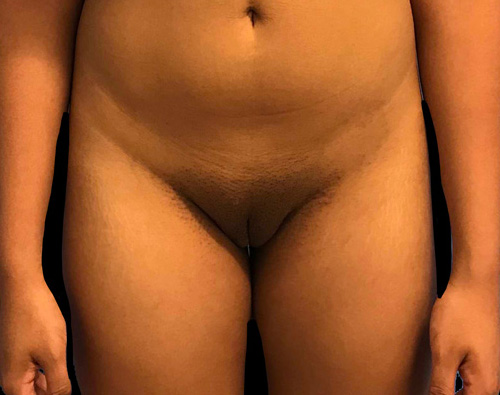
What Is Vaginoplasty?
During the vaginoplasty procedure, Dr. Keith and Dr. Marano expertly reconstruct your existing native tissue to create a vulva and vagina that are sensate, functional, and aesthetically pleasing. “Sensate” refers to the preservation of erogenous sensation, “functional” ensures the ability to urinate and, if desired, engage in penetrative intercourse, and “aesthetic” means that the vagina will closely resemble that of a cisgender female.
What Are the Different Types of Vaginoplasty?
Dr. Keith and Dr. Marano in New York City/New Jersey offer several different surgical techniques for vaginoplasty. During your private consultation, they will help you select the best approach based on your unique goals and anatomy.
Penile Inversion Vaginoplasty with Peritoneal Grafts
Penile inversion is considered the gold-standard approach to vaginoplasty and is the most common type of vaginoplasty we perform. This is typically performed in a single stage that is completed in conjunction with a reconstructive urologist. Your surgeon will perform the necessary steps, including orchiectomy, penectomy, dissection, labiaplasty, clitoroplasty, and creation of a vaginal canal by reconstructing your existing native tissue. Through robotic port incisions on the abdomen, the urology team creates a space for the canal between the bladder and rectum. With the use of the robot, we are able to safely dissect this space between two important organs with good visualization. While using the robot, we are able to harvest a piece of peritoneum, a membrane that lines the abdomen and pelvis, to attach to the new vaginal canal. By incorporating a peritoneal graft, the vaginal canal will become self-lubricating.
Peritoneal Pull Through Vaginoplasty
When the penile inversion with peritoneal grafting method is not sufficient for creating ample vaginal depth that will support receptive penetrative intercourse, vaginoplasty with peritoneal flaps may be an excellent option. In this vaginoplasty type, instead of a piece of peritoneal graft, a significant portion of peritoneum is used to create the canal in order to increase depth. Your existing tissue will create the distal, or bottom, portion of the canal, while the superior, or top, portion of the canal is made entirely of peritoneum.
Minimal Depth Vaginoplasty
Minimal depth, or zero-depth, vaginoplasty is for patients who do not wish to create a larger vaginal canal that is able to receive receptive intercourse. In this method, there is no urologist involved in the case, as there is no internal space created for the canal. Rather, your surgeon will create a vulva and minimal depth canal using your native tissue that you currently have. Although this method creates a minimal depth canal, you may still be able to dilate with smaller dilator sets if desired.
Who Are the Best Candidates?
To undergo vaginoplasty, you will need to be over 18 and have 2 referrals from qualified mental health professionals attesting to your gender dysphoria and desire to get bottom surgery. The letters will need to correspond to the WPATH Standards of Care guidelines. You will also need to be on HRT for a full year (or detail in writing why you don’t want to be on HRT) and will need to have a BMI (body mass index) of 35 or below. Higher BMIs can lead to high risks of surgical complications.
Dr. Keith and Dr. Marano, who you will meet during your consultation in New York City/New Jersey, devote significant time to the consultation process. They will answer all of your questions and concerns in depth and ensure you have realistic expectations for your results.
How Should I Prepare for Vaginoplasty?
Ahead of your vaginoplasty surgery, there will be several requirements that our office will need prior to scheduling your surgery. These preparatory steps are as follows:
- Provide Mental Health Letter – Many insurance providers and surgical guidelines require two letters from qualified mental health professionals confirming a diagnosis of gender dysphoria and the patient’s readiness for surgery. These letters should follow WPATH (World Professional Association for Transgender Health) standards and address the patient’s understanding of the procedure and its implications. You will need to have been on hormone replacement therapy for a full year, which must be explained in the letters. Our team will assist in ensuring the proper language is used and the provider is appropriately credentialed.
- Quit Smoking – Nicotine constricts blood vessels and significantly increases the risk of complications, including poor wound healing, tissue loss, as well as difficulty with intubation at the beginning of surgery. Patients must stop using all nicotine products—including cigarettes, vapes, nicotine patches, and gum—at least 4-6 weeks before and after surgery. If you are an active nicotine smoker, we will ask you to complete a nicotine blood test as part of your preoperative lab panel to optimize wound healing.
- Manage Medications – You may be asked to discontinue certain medications that increase surgical risks ahead of surgery. At your consultation visit, we will discuss these medications in further detail.
- Well-Controlled Medical or Mental Health Issues / Medical Clearance – To ensure a safe surgery and post-operative recovery, all patients will be required to visit their primary care provider for preoperative clearance 3-4 weeks ahead of surgery. Patients with underlying medical conditions such as diabetes, high blood pressure, asthma, or psychiatric conditions should have them well-managed ahead of surgery with additional clearance letters from corresponding specialists. At your consultation, specific medical clearance instructions will be discussed in further detail. In addition to a medical optimization letter from your PCP, you will also need to complete a basic blood work panel and EKG ahead of surgery.
- BMI Cutoff – To decrease the risk of postoperative complications and wound healing, we require that you maintain a body mass index (BMI) under 32 for penile inversion vaginoplasty and peritoneal pull-through vaginoplasty methods.
- Hair Removal – Laser hair removal or electrolysis can be helpful prior to your vaginoplasty to prevent hair growth in the vaginal canal. At GAMMA, we perform laser hair removal in our New York City and New Jersey offices. Although hair removal is not mandatory for all patients, your surgeon will discuss if hair removal is required before your surgery. Templates of hair removal are linked below.
- Insurance Coverage – GAMMA works with various insurance providers to help patients access gender-affirming surgery. Our team assists with insurance verification, prior authorization, and necessary documentation. Patients should check with their insurance carrier regarding coverage criteria, including mental health letters and medical clearance requirements.
- Complete Your Consultation – You will undergo a detailed consultation with Dr. Keith or Dr. Marano to ensure your expectations are realistic and your health supports the treatment process. Preoperative photos and measurements will be taken during your consultation for surgical planning and optimization. Our team will discuss the risks and benefits, recovery and results, of chest feminization surgery.
What to Expect On the Day of Surgery
On the day of surgery, patients should arrive at the hospital on time and follow preoperative fasting instructions. Ahead of your surgery, you should do the following:
How to Prepare for Hospital Stay
- Pack comfortable clothing, toiletries, and personal items.
- Arrange for post-op care and transportation home or to a recovery location.
- Expect limited mobility in the first few weeks post-surgery.
Recovery
Surgery will take roughly 6-8 hours in the operating room. After surgery is finished, you will be moved to the recovery unit for a few hours prior to going to your hospital room that you will be in for one week. During your one week hospital stay, you will be carefully monitored daily by our team, the urology team, the nurses on the floor, and the physical therapists who will assist you in walking through the halls. You will have a catheter draining your urine, surgical drains, and antibiotic vaginal packing that will remain in place while you’re admitted to the hospital. After 1 week, your surgeon will bring you back to the operating room under light sedation to remove the catheter, packing, and surgical drains. Upon recovery from this light sedation, you will be discharged from the hospital to home while being accompanied by a responsible adult.
- Dilation – During discharge, the hospital will provide you a set of SoulSource dilators that we recommend for postoperative dilation. You do not need to purchase these on your own. Once you are discharged from the hospital, you will not need to dilate on your own until you see us in the office for your first postoperative vaginoplasty visit. At your first visit, we will demonstrate and coach you through the proper dilation technique to ensure you are using maximum depth. After your first postoperative visit, you will begin dilating on your own three times per day for 15 minutes each time. Dilation is a key component of your postoperative course in order to maintain a patent canal, as lack of dilation can lead to stricturing, scarring, and ultimately loss of depth and width.
- Pain – Pain will be managed with medications in the hospital and at home, and gradually will improve over weeks.
- Dressings/Showering – Showering at home is permitted upon discharge from the hospital. We recommend purchasing maxi-pads to put in the lining of your underwear in case of bleeding.
- Activity Restrictions – No heavy lifting, strenuous exercise, or sexual activity for at least 6–8 weeks. Light walking is encouraged to promote circulation and prevent blood clots. Patients should avoid bending, squatting, or straining during the first several weeks.
Timelines:
- Time Off Work – Desk jobs require 6–8 weeks off work. Physically demanding jobs can require 10–12 weeks or longer.
- Sexual Activity – Refrain from sexual activity for 3 months (12 weeks) after surgery to allow for healing, dilation ease, and swelling to subside.
- Healing – Although you will notice great strides in healing weekly, your full healing and final results are usually seen around the 12 month postoperative mark.
Postoperative Appointments
Typically, our postoperative appointment schedule is as follows:
-
- Weekly for the first month after surgery
- Biweekly for the second month after surgery
- Monthly appointment thereafter, and tailored to patients specifically
Risks and Complications
Dr. Keith and Dr. Marano will go over these risks in greater detail during the consultation process so you are fully aware and informed. Possible risks include:
- Pain – We provide you with ample pain medications during your hospital stay and upon discharge from the hospital.
- Wound Separation – Incisions may take time to heal properly. Wound separation is common in certain areas of the vulva.
- Discharge – Temporary discharge from healing surgical sites and the vaginal canal. Discharge is common for the first 9-12 months after surgery.
- Bleeding – Bleeding is common with vaginoplasty and dilation, but excessive post-surgical bleeding may require intervention.
- Canal Stenosis – Loss of canal depth and width due to scarring and stricturing, likely in the setting of dilation noncompliance.
- Infection – Can occur at the mons, vulva, or vaginal canal.
- Sensation Loss – Varies based on nerve connections and healing.
Fistula – An abnormal connection between the vaginal canal and nearby structures, such as the rectum or bladder.
What Sets Us Apart?
Our team at Gender Affirming Medical and Microsurgical Associates (GAMMA) in New York City and New Jersey is known for providing the highest-level care in an affirming environment. We utilize today’s most progressive and cutting-edge techniques to provide the highest level of service possible. Our goal is to help transgender, nonbinary, and gender nonconforming individuals achieve their unique appearance goals and thrive with confidence, security, and peace of mind.
Dr. Drew Marano
Dr. Drew Marano is an accomplished, board- certified, and fellowship-trained plastic and reconstructive surgeon who has devoted his career to the art of gender affirmation surgery. He graduated from Rutgers New Jersey Medical School at the top of his class, receiving AOA honors before embarking on a competitive six-year Integrated Plastic and Reconstructive Surgery Residency at Columbia University/Cornell University in New York City. Following his residency, Dr. Marano was selected as the first-ever Harvard University Complex Gender and Microsurgery Fellow, during which time he underwent advanced training in groundbreaking and innovative surgical techniques. He is a prolific author, researcher, and lecturer who has contributed to over 40 publications and presentations at regional and national meetings. Dr. Marano offers ongoing support for transgender patients as they navigate their unique and rewarding journey of transitioning.
Dr. Jonathan Keith
Dr. Jonathan Keith is a renowned, fellowship-trained, board-certified plastic surgeon known for his progressive approach to microvascular surgery. He is an active member of the World Professional Association for Transgender Health and the founder of the Rutgers Center for Transgender Health. In 2018, Dr. Keith created the first multidisciplinary clinical program for transgender patients in New Jersey and was the first surgeon in the state to perform a female-to-male phalloplasty for gender affirmation. Regarding his extensive educational background, Dr. Keith completed a demanding seven-year residency at the University of Pittsburgh, one of the nation’s most elite and well-regarded plastic surgery training programs. As a testament to his skill and artistry, in 2012, he received the Stephen S. Kroll Fellowship in microsurgery at the University Hospital of Gent, Belgium. Today, Dr. Ketih performs a range of complex and delicate procedures to assist transgender and nonbinary individuals in achieving their ideal appearance, including DIEP flaps for breast reconstruction, vaginoplasty, and phalloplasty.